4D-Printing

Research group '4D-Printing'

With 4D printing, previously static 3D-printed components can change their shape or function over time. To realise this, special materials are required that enable such a change. Therefore, at its core, 4D printing involves the use of intelligent materials in additive manufacturing. These intelligent materials are also known as smart materials. Smart materials are materials that react to an external stimulus in a useful way. This means that the properties of smart materials can be directly influenced by environmental factors. These influences can affect the shape, volume, colour, tension and other properties of the materials. It is this property that forms the basis for 4D printing.

Potential future applications of 4D printing technology include the medical sector and soft robotics. As this technology is still in its infancy, it is likely that more applications and potential will emerge in the future.

The '4D Printing' research group is currently conducting experimental investigations and simulations on the topic of '4D printing'. The focus is currently on smart polymer materials and polymer composites with magnetic properties.

The following video illustrates the process of 4D printing a soft gripper from a magnetically responsive material. Firstly, the creation of the 3D drawing and the actuation of the printed body are illustrated and described in detail. This is followed by video sequences of these steps. At the end of the video, the actuation is monitored for flow density by placing a Hall probe directly under the soft gripper. Connected to a teslameter, the magnetic flux density output is displayed in the bottom right-hand corner of the screen in units of mT.


The video below shows a simple positioning and gripping system made from a shape-memory polymer (SMP). This material can change shape in a targeted manner when heated. Combined with a polylactide and magnetic particle composite material, it is used to retrieve the marble from the bottle.

The direct programming of a stent-like prototype for biomedical applications is shown in the following video. A flat lattice structure from the 3D printer serves as the basis, which is filled with water-soluble PVA to ensure the individual cavities in the lattice structure. The special feature here is that the desired shape change is already imprinted in the 3D printed component during the printing process and no subsequent programming is required. This lattice structure is then heated in an initial water bath (T1) and then thermomechanically preformed into a hollow cylinder. The grid is then deformed under the influence of heat in another water bath (T2>T1), whereby the outer diameter of the hollow cylinder increases.

Further Information

Current research focuses on magnetic polymer composites and magnetic-mechanical simulation. Materials consisting of an elastic polymer with embedded magnetic particles, such as neodymium, are analysed, tested and simulated. To enable targeted movement, the important requirements of the material are first identified and analysed experimentally. In parallel, COMSOL multiphysics simulation software is used to simulate targeted movement in response to an external magnetic field. The knowledge gained should enable targeted, simple movements of the composite materials to be reliably realised and simulated.

Summer term 25: Additive manufacturing workshop for students on the topic of 4D printing of soft robots — development, design and production of a soft robot in the form of a bionic muscle.

Publications to the research field '4D-Printing' so far:


  • Kehret, D., Junk, S., Einloth, H., Rapp, B. E.: 4D printing of magnetoresponsive soft gripper and phenomenological approach for required magnetical actuation field. The International Journal of Advanced Manufacturing Technology. 2024. Springer Link. https://doi.org/10.1007/s00170-024-14605-5
  • Junk, S., Einloth, H., Velten, D.: A Methodical Approach to Product Development in 4D Printing Using Smart Materials. In: H. Almeida et al. Progress in Digital and Physical Manufacturing. ProDPM 2021. Springer Tracts in Additive Manufacturing. Springer, Cham, 2023, https://doi.org/10.1007/978-3-031-33890-8_12
  • Junk, S., Kehret, D., Einloth, H., : Application of Magnetoresponsive Materials in 4D-Printing, Hrsg.: Bernhard Müller: Fraunhofer Direct Digital Manufacturing Conference DDMC 2023 Conference Proceedings, 2023, Berlin, Germany, ISSN: 978-3-8396-1895-0
  • Junk, S., Einloth, H., Velten, D.: 4D Printing: A Methodical Approach to Product Development Using Smart Materials. Machines 11, no. 11: 1035. 2023. https://doi.org/10.3390/machines11111035

News


4D Printing research group visited FormNext 2025 in Frankfurt

In the middle of November, the focus at the leading international trade fair for additive manufacturing was on getting to know the latest technological trends.

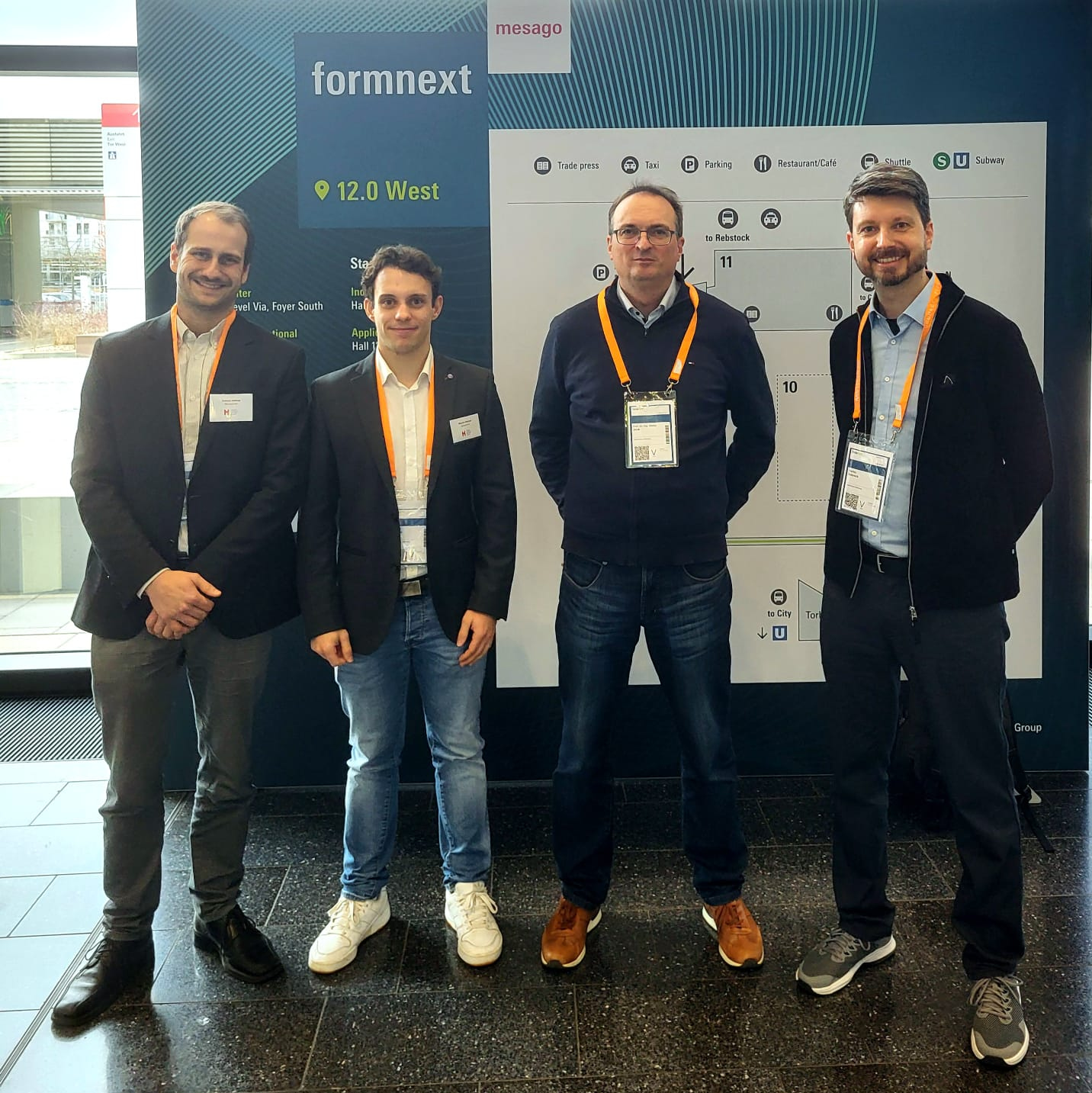
The 4D Printing Group from Offenburg University of Applied Sciences at FormNext in Frankfurt. From left to right: Daniel Kehret, Marvin Henkel, Prof. Dr.-Ing. Stefan Junk, Steffen Schrock
© Hochschule Offenburg

The 4D Printing Group from Offenburg University of Applied Sciences at FormNext in Frankfurt.

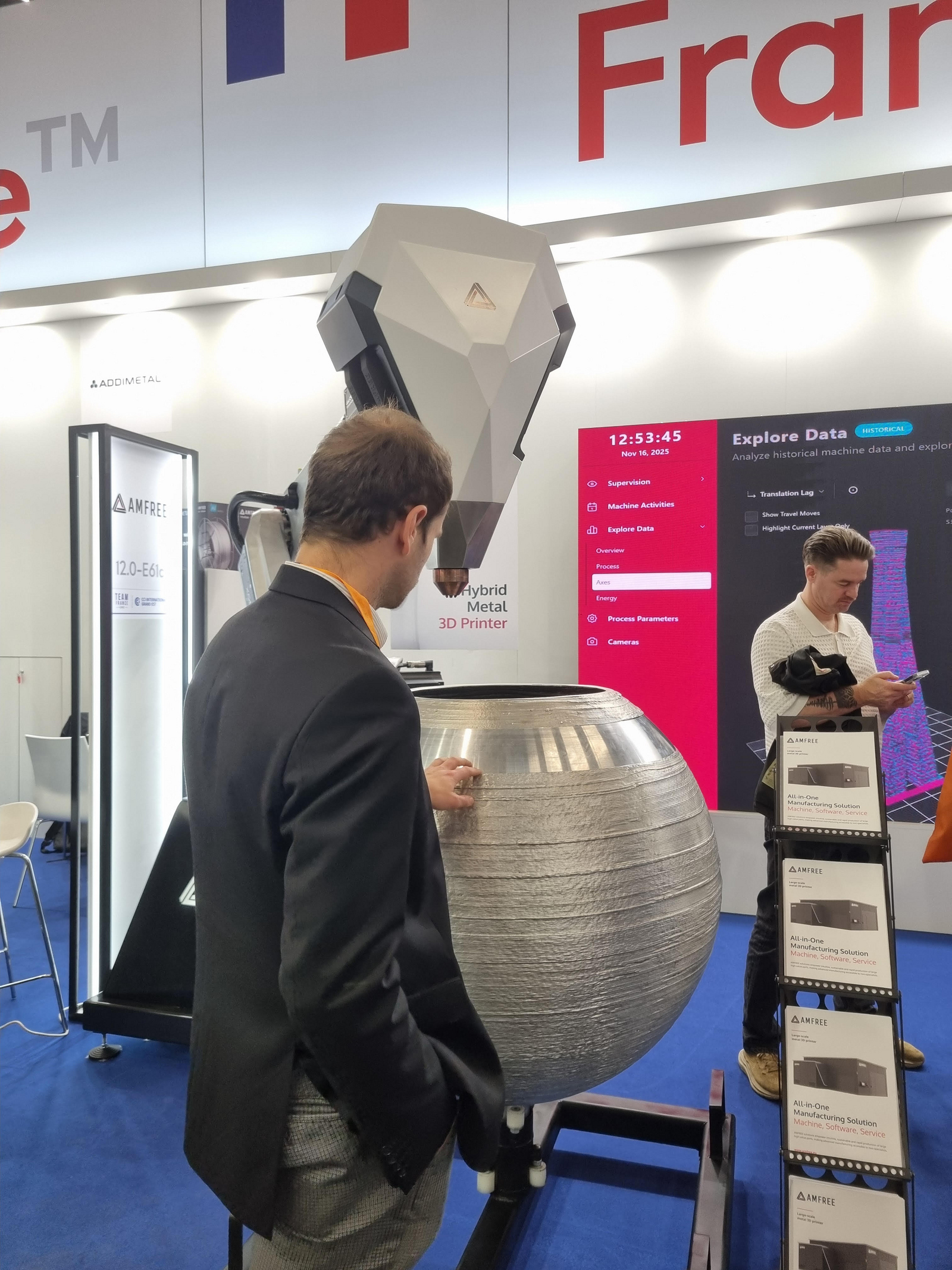
Daniel Kehret admires a large 3D-printed metal vase manufactured by a robot-assisted hybrid metal 3D printer from AMFree.
© Hochschule Offenburg

Large-format, metal-printed vase from a robot-assisted, hybrid metal 3D printer manufactured by AMFree.

Part of the 4D Printing Research Group at Offenburg University of Applied Sciences visited the leading international trade fair FormNext in Frankfurt to learn about the latest developments in additive manufacturing and establish contacts with leading companies and research institutions worldwide. FormNext is considered the most important trade fair for additive manufacturing and industrial production technologies and celebrated its tenth anniversary this year with a total of 803 exhibitors. For the research group, the visit was a valuable opportunity to gain insights into current trends, innovative materials, and future technologies that are relevant to their own research work.

This year's trade fair focused in particular on the economic role of additive manufacturing and its concrete added value for numerous industrial sectors. The exhibition showcased particularly practical applications that have been developed in recent years. The field of metal-based additive manufacturing was well represented. In addition the field of pellet 3D printing also had a stronger presence this year. This means that a wide range of injection molding materials can be processed for 3D printing, even without the addition of additives. Increasing industrialization, which is also characterized by robot-assisted processes, was a key theme at this year's event.

Visiting the FormNext trade fair also provided an excellent opportunity to exchange ideas with international partners from industry and science. This included maintaining contacts with scientists from the Portuguese 4D printing industry. Daniel Kehret, who recently received the Young Researcher Award at Pro DPM 2025 in Leiria, was able to meet up again with fellow scientists from the Politecnico de Leiria whom he had met at the conference.

In addition to visiting the trade fair, the focus was on discussions with technology providers, material manufacturers, and scientific institutions. The 4D printing research group established contacts that could enable future collaborations or joint projects in the field of magnetic-responsive elastomer (MRE) processing. Visiting FormNext 2025 was an important step for the 4D printing research group at Offenburg University of Applied Sciences in identifying new technical trends at an early stage, deepening their knowledge, and strengthening networking within the specialist community.